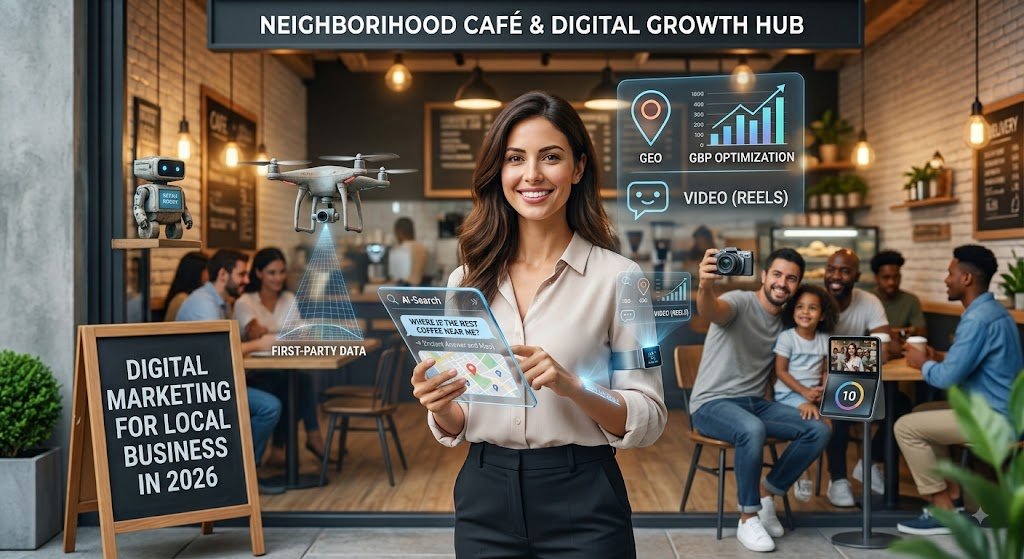
The digital marketing landscape for local businesses has undergone a seismic shift. If you are still relying on the same tactics you used even a couple of years ago, you are likely leaving money on the table. In 2026, it is no longer about simply having a website or posting occasionally on social media. The future belongs to businesses that embrace artificial intelligence, hyper-personalization, and community-driven authenticity.
For local businesses—whether you run a neighborhood café, a boutique fitness studio, or a regional plumbing service—the playing field has leveled. Advanced, enterprise-grade tools are now accessible to everyone. This means your competitive edge lies entirely in how strategically you implement them.
Let’s break down the most critical digital marketing trends for local businesses in 2026 and how you can leverage them to drive real, measurable foot traffic and revenue.
1. The Rise of AI Search and Generative Engine Optimization (GEO)
We are officially in the era of AI-first search. Google and other search engines have evolved to answer user queries conversationally, right on the results page, often before a user even clicks a link. This phenomenon, known as “zero-click searches,” means that the old method of writing fluffy, generic blog posts just to capture traffic is dead.
Instead, local businesses must focus on Generative Engine Optimization (GEO). AI search engines prioritize direct, intent-rich answers. To adapt:
- Answer Questions Immediately: Structure your website content to answer specific customer questions in the first two sentences of a page. If your opening is vague, the AI will simply move on to a competitor.
- Focus on E-E-A-T: Experience, Expertise, Authoritativeness, and Trustworthiness are your strongest barriers against generic AI content. Share real local case studies, before-and-after photos, and authentic testimonials.
- Target Conversational Keywords: Optimize for conversational, long-tail phrases (e.g., “Where is the best emergency plumber near downtown?” rather than just “plumber”).
2. The Hyper-Local Advantage and Your Google Business Profile
When a potential customer searches for a local service, AI search and map results appear long before organic website listings. In 2026, your Google Business Profile (GBP) is arguably more critical for first discovery than your actual website.
To dominate hyper-local SEO, your profile must be flawlessly maintained and continuously updated:
- Constant Activity: Treat your GBP like a micro-social platform. Regularly update your profile with new photos, limited-time offers, and events.
- Review Management: Actively encourage satisfied customers to leave detailed, keyword-rich positive reviews. A comprehensive local SEO campaign can dramatically improve your visibility in the highly coveted “local pack”.
- Local Schema Markup: Ensure your website uses location-based schema markup to help search engines instantly understand your service area and business details.
3. Conversational Marketing and the Messaging Revolution
Customers in 2026 have zero patience for delayed responses. They expect instant answers and seamless booking experiences. Conversational marketing—powered by AI chatbots, Messenger, and WhatsApp—is now a primary driver of local conversions.
For local businesses, messaging apps are no longer just for customer support; they are full-funnel marketing and commerce channels:
- Instant Booking: Service businesses are using automated WhatsApp and Messenger flows for appointment scheduling, drastically reducing friction and increasing booking rates.
- 24/7 Automated Service: Deploy AI chatbots on your website to handle common inquiries—like hours of operation, pricing, or menu items—around the clock.
- Hyper-Personalized Outreach: Instead of generic email blasts, businesses are using behavioral data to trigger highly personalized offers directly to a customer’s phone.
4. Short-Form Video and the Demand for Authenticity
While AI can generate text and images in seconds, it currently lacks the emotional comprehension and authenticity that humans crave. Because polished, AI-generated content is everywhere, consumers are aggressively gravitating toward genuine, transparent brands. Today, trust is the ultimate currency.
Short-form video on platforms like Instagram Reels, TikTok, and YouTube Shorts remains the most effective way to build that trust locally:
- Show, Don’t Tell: Give behind-the-scenes tours of your storefront, introduce your staff, or document a day in the life of your business.
- User-Generated Content (UGC): Turn your best customers into micro-creators. Authentic videos of real locals enjoying your business perform significantly better than highly produced corporate ads.
- Community Integration: Actively participate in the local community and film it. Sponsorships of local events or collaborative videos with neighboring businesses create powerful, shareable narratives.
5. First-Party Data and Precision Personalization
With privacy regulations tightening and the continuous decline of third-party tracking, owning your audience data is paramount. In 2026, digital marketing is less about massive volume and more about surgical precision.
Local businesses must prioritize building first-party data—the information customers willingly give you directly:
- Value-Driven Opt-Ins: Incentivize customers to share their phone numbers and emails by offering exclusive local perks, VIP access, or loyalty programs.
- Behavioral Segmentation: Do not treat all customers the same. Segment your subscriber lists based on purchase history or specific interests. Highly personalized email campaigns tailored to these segments can achieve massive open rates and unmatched ROI.
- Predictive Paid Media: Use your first-party data to power targeted Pay-Per-Click (PPC) and Meta ads. AI tools can now optimize campaigns in real-time based on your specific audience data, ensuring your ads are only shown to high-intent local buyers and maximizing your ad budget.
Conclusion: Moving Forward in 2026
The winning digital marketing strategies of 2026 require a delicate balance between high-tech automation and high-touch human connection. Artificial intelligence is an incredible tool for scaling your operations—handling mechanically repeatable tasks, predicting trends, and optimizing ad spend. However, the core of your local business success remains rooted in community, trust, and exceptional service.