Digital Marketing Trends in India 2026: What Businesses Need to Know
Digital marketing in India is entering a new phase in 2026. Artificial intelligence, short-form video, creator marketing, WhatsApp commerce, and AI-powered search are changing how customers discover brands and make purchase decisions.
For businesses, simply having a website or running social media ads is no longer enough. Brands need to understand where customers are discovering information and how technology is influencing their buying journey.
Here are the key digital marketing trends in India for 2026.
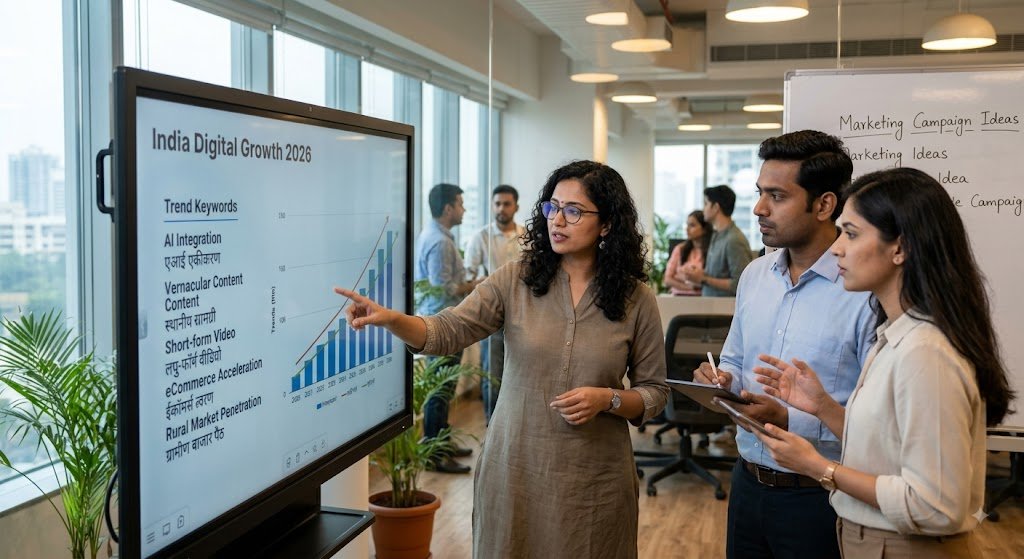
1. AI-Powered Marketing Is Becoming the New Standard
Artificial intelligence is moving beyond content generation. Businesses are increasingly using AI for customer segmentation, campaign optimization, personalization, customer support, ad creation, and marketing automation.
AI can help marketers analyze large amounts of customer data and quickly identify patterns. This allows businesses to create more relevant campaigns while reducing repetitive manual work.
However, successful brands will use AI as a productivity tool rather than relying on it for everything. Human creativity, strategy, originality, and brand voice remain important.
2. SEO Is Evolving Into AI Search Optimization
One of the biggest changes in 2026 is the rise of AI-powered search.
Consumers are increasingly using AI platforms to research products, compare services, ask questions, and discover recommendations. Retailers are already adapting their websites and content to attract AI-driven shopping traffic.
This means marketers need to think beyond traditional Google rankings.
GEO (Generative Engine Optimization) and AEO (Answer Engine Optimization) are becoming important strategies. Businesses should create clear, authoritative, useful content that AI systems can understand, reference, and potentially recommend.
3. Short-Form Video Continues to Dominate
Instagram Reels, YouTube Shorts, and other short-form video formats remain powerful tools for reaching Indian audiences.
Video allows brands to demonstrate products, educate customers, tell stories, and build trust quickly. According to a 2026 Meta–Retailers Association of India report, Reels and creator campaigns are contributing significantly to retail performance.
For businesses, the focus should not simply be on creating more videos. The goal should be to create useful, entertaining, relatable, and memorable content.
4. Creator Marketing Is Becoming More Performance-Driven
Influencer marketing is shifting from celebrity endorsements toward creators who have strong relationships with specific communities.
Micro and niche creators can offer businesses targeted audiences and greater authenticity. Creator content can also help customers see how a product or service works in real-life situations.
Brands should therefore evaluate creators based on audience relevance, engagement, credibility, and conversions, rather than follower count alone.
5. WhatsApp Is Becoming a Marketing and Commerce Channel
WhatsApp is becoming much more than a customer-support platform in India.
Businesses can use WhatsApp for product discovery, lead generation, personalized communication, customer service, and sales. Meta’s 2026 research with the Retailers Association of India highlights WhatsApp’s growing role in India’s shopping journey, with messaging increasingly connecting discovery and purchase.
For local businesses and small companies, WhatsApp can be particularly useful because it allows businesses to communicate directly with potential customers.
6. Regional-Language Marketing Will Grow
India’s digital audience is extremely diverse. Brands that communicate only in English may miss opportunities among customers who prefer regional languages.
In 2026, businesses can use AI tools to assist with multilingual content creation, while human review ensures that translations remain natural and culturally relevant.
Content in languages such as Hindi, Malayalam, Tamil, Telugu, Bengali, Marathi, and Kannada can help brands connect with audiences beyond major metropolitan cities.
7. Social Commerce and Omnichannel Marketing Are Growing
The customer journey is becoming less linear.
A consumer might discover a product through a Reel, research it through an AI tool, ask questions on WhatsApp, visit a physical store, and finally purchase online.
This is why omnichannel marketing is becoming increasingly important. Meta’s India research found that consumers frequently move between online and offline research before purchasing.
Brands need to provide a consistent experience across websites, social media, messaging platforms, marketplaces, and physical stores.
8. First-Party Data Will Become More Valuable
As privacy expectations increase, businesses need stronger relationships with their own audiences.
Email subscribers, CRM data, loyalty programs, website interactions, and WhatsApp customers can provide valuable first-party data.
Instead of depending entirely on rented audiences from advertising platforms, businesses should build owned customer communities and use data responsibly to deliver relevant experiences.
9. Authenticity Will Matter More in the Age of AI
AI makes it easier than ever to produce content. That also means the internet is becoming crowded with similar-looking AI-generated articles, images, and videos.
As content volume increases, authenticity becomes a competitive advantage.
Original research, customer stories, expert opinions, product demonstrations, reviews, and real experiences can help brands stand apart from generic AI-generated content.
Conclusion
Digital marketing in India in 2026 is moving toward a combination of AI, human creativity, video, creators, conversational commerce, and personalized experiences.
Businesses that succeed will not necessarily be the ones using the most technology. They will be the ones that use technology to understand customers better while maintaining trust and authenticity.
For Indian businesses, the biggest opportunity is to combine AI-powered marketing with local insight, regional content, creator partnerships, short-form video, and direct customer communication.
The future of digital marketing is not just about reaching more people. It is about being discovered in the right place, providing value at the right moment, and building relationships that turn attention into long-term customers.